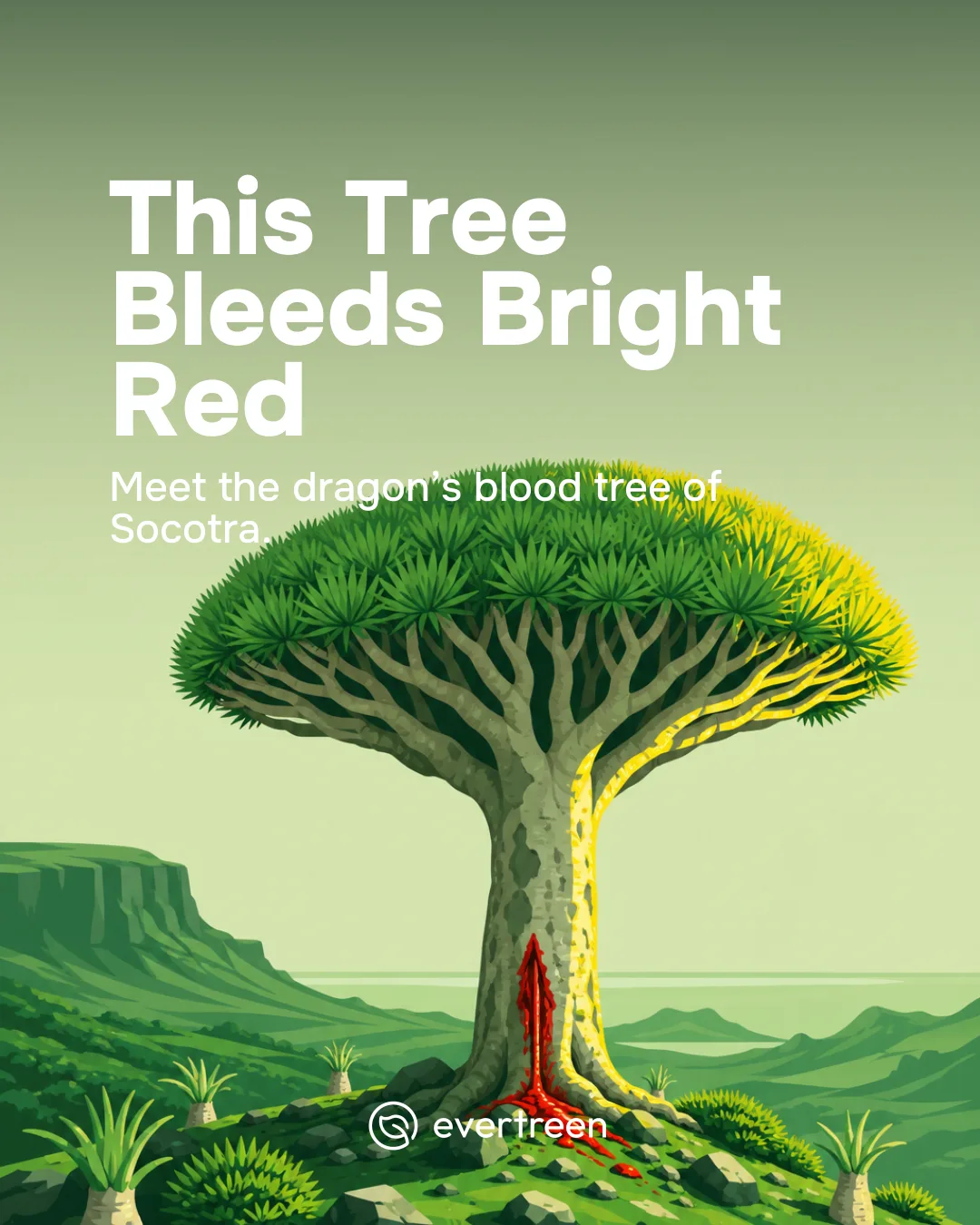
The dragon's blood tree (Dracaena cinnabari) is an umbrella-shaped evergreen that grows wild only on Socotra, a Yemeni island in the Arabian Sea. It is named after the dark red resin that seeps from its bark. The IUCN lists it as Vulnerable, largely because grazing and drought stop young trees from replacing old ones.
What is the dragon's blood tree?
The dragon's blood tree is a long-lived member of the genus Dracaena, in the asparagus family. Unusually for a tree, it is a monocot, the plant group that includes palms and grasses. Most monocots cannot thicken their stems the way oaks do, but dragon trees have a distinctive form of secondary growth that lets the trunk widen slowly over many years.
Its native range is the Socotra archipelago, off the Horn of Africa. Plants of the World Online, the botanical database run by Kew, records it as native to Socotra only. It grows mostly on limestone plateaus and in the granite Haggeher mountains, where mist is frequent.
A species that grows naturally in only one place is called endemic, and Socotra is full of them. Long isolation from Africa and Arabia has produced a large share of plants found nowhere else, including several frankincense trees. This flora is a main reason the archipelago is a UNESCO World Heritage Site.
Why is the dragon's blood tree shaped like an umbrella?
The crown grows as a dense, upturned dome. After a shoot flowers, it typically divides into two or more new branches. Repeated over centuries, this produces a tightly packed canopy with stiff, sword-shaped leaves clustered at the branch tips. The shape is thought to suit a dry, windy island in several ways:
- Fog capture. Rainfall on Socotra is low and irregular, but the highlands are often wrapped in mist. The upward-pointing leaves are believed to intercept droplets, which run down the branches towards the trunk and roots.
- Shade. The dense crown shades the ground beneath it, reducing evaporation and keeping the soil moist for longer.
- Wind. A compact, rounded crown may help the tree cope with the strong winds of the summer monsoon.
The cooler, damper ground under mature trees can also give seedlings a better start, provided animals do not eat them first.
Where does the red resin come from, and what is it used for?
When the bark is damaged, the tree exudes a resin that hardens into dark red droplets, often called "tears", and is generally understood to help seal the wound. On Socotra it has traditionally been collected from natural cracks or by scraping the bark, and it is sold locally under the Arabic name dam al-akhawain, often translated as "blood of the two brothers".
Traditional uses on the island include dyeing, decorating pottery, colouring lips and treating wounds and skin complaints. Socotran resin was traded across the ancient world, and "dragon's blood" later appeared in European varnishes, pigments and alchemical recipes. An old legend, retold by Roman writers, held that it was the blood of a dragon killed fighting an elephant. Traditional use does not show that the resin is safe or effective as a modern medicine.
The name is not unique to this tree. Several unrelated plants produce red resins or saps sold as "dragon's blood":
| Source plant | Where it grows | What the "blood" is | Typical uses |
|---|
| Socotra dragon's blood tree (Dracaena cinnabari) | Socotra archipelago only | Resin that seeps from the bark and dries into droplets | Dye, pottery decoration, varnish, incense, traditional medicine |
| Canary Islands dragon tree (Dracaena draco) | Canary Islands, Madeira, Cape Verde and parts of Morocco | Resin from the trunk and branches | Historically a dye and varnish ingredient; widely grown as an ornamental |
| Rattan palms (such as Daemonorops draco) | Southeast Asia | Red resin coating the scaly fruit | Incense and dyes; a common source of commercially traded dragon's blood |
| Sangre de drago (Croton lechleri) | Western Amazon | Red latex tapped from the bark | Traditional wound care in parts of South America |
Is the dragon's blood tree endangered?
The IUCN Red List currently assesses Dracaena cinnabari as Vulnerable, meaning it faces a high risk of extinction in the wild if current pressures continue. Its outlook depends on whether new generations can establish.
The central problem is regeneration, the natural replacement of old trees by young ones. In many stands almost every tree is mature, and young trees are rare outside places goats cannot reach, such as cliffs and steep gorges. The main pressures are:
- Grazing. Free-ranging goats and other livestock eat seedlings, so few survive their first years.
- A drier climate. Seedlings depend on mist and seasonal moisture to take hold; less of either makes establishment harder.
- Storms. Severe cyclones, including two that struck the archipelago in 2015, are reported to have uprooted many mature trees.
- Slow growth. A young tree takes many years to reach flowering size, so lost mature trees are not quickly replaced.
Because the species grows nowhere else, there is no other wild population to fall back on. Mature trees provide shade, moisture and shelter for insects, reptiles and birds, which is why the tree is often described as a keystone species of the Socotran highlands.
Why seedling protection and restoration matter
The dragon's blood tree shows that saving a species is not only about the trees already standing. A stand of old, healthy-looking trees can still be in decline if nothing replaces them. On Socotra, conservation work has focused on that gap: raising seedlings in nurseries, planting them in fenced plots and shielding young trees from livestock until they are tall enough to survive.
Several lessons carry over to forest restoration elsewhere:
- Survival matters more than planting numbers. A seedling only counts if it lives through its first dry seasons, so protection and follow-up care often decide the outcome.
- Native species suit the site. Trees adapted to local rainfall, soils and wind are more likely to establish.
- Local people are central. Herders and nursery workers decide whether young trees are protected, so restoration works best when it also brings paid work locally.
Trees funded through Evertreen are planted with local partners and farmers in named projects, and planting follows the local season, typically one to six months after funding. For the wider case, read our article on why restoring forests matters for climate and biodiversity and our guide to the role of big trees in ecosystems.
Frequently asked questions
Why is it called the dragon's blood tree?
The name comes from its dark red resin, which looks like dried blood. Ancient and medieval traders sold several red resins as "dragon's blood", and legends linked them to real dragons.
How old can a dragon's blood tree get?
Large trees are thought to be several centuries old, but exact ages are hard to measure. As a monocot, the tree does not lay down clear annual growth rings, so estimates usually rely on growth rates and the number of branching points in the crown.
Is dragon's blood the same as cinnabar?
No. Cinnabar is a red mineral, mercury sulphide, once ground to make the pigment vermilion. In the ancient world the two red substances were sometimes confused under similar names, which is where the species name cinnabari comes from. Dragon's blood is a plant resin.
Can you grow a dragon's blood tree outside Socotra?
It is grown in some botanical gardens and by specialist collectors, usually in warm, dry conditions or under glass. It grows very slowly and needs free-draining soil and frost protection, and cultivated plants do not replace wild populations.
To see where trees funded through Evertreen are planted with local partners, explore Evertreen's tree-planting projects.