

How Much CO2 Does a Tree Absorb?
1 Jul 2026 in About our trees
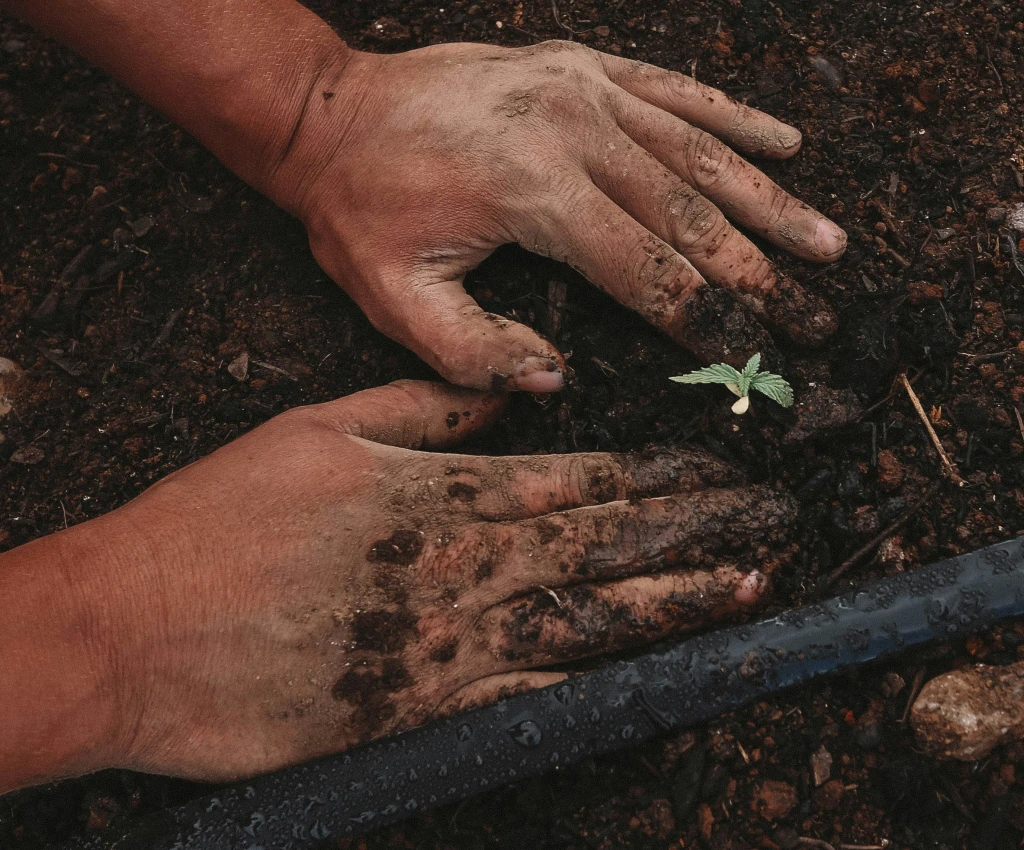
A tree absorbs roughly 10–40 kg of CO₂ per year once established, with a commonly used average of about 25 kg/year — but the real figure depends heavily on species, climate, age and survival rate. Fast-growing tropical species absorb more per year; young seedlings absorb very little in their first years; and a credible programme must account for the trees that don't survive.
What determines a tree's CO₂ absorption
- Species. Growth rate and wood density vary enormously — a mangrove or tropical pioneer behaves nothing like a temperate oak.
- Climate & site. Rainfall, temperature, soil quality and competition drive growth speed more than most people expect.
- Age. Absorption is low in the early years, peaks during vigorous growth, then slows as the tree matures.
- Density and management. Spacing, thinning and protection from grazing or fire all change the outcome.
- Survival. Honest accounting discounts for mortality — quoting per-planted-tree figures without it overstates impact, sometimes badly.
The S-curve nobody puts in the headline
Carbon uptake is not linear, and this is the single most misunderstood point. A newly planted seedling absorbs almost nothing measurable in its first two or three years — it is busy building roots. Uptake then accelerates through the tree's vigorous growth phase, and eventually plateaus as the tree matures and growth slows.
Two practical consequences follow. First, a tree planted today does not deliver its 25 kg this year; it delivers a growing stream over decades. Second, any figure quoted “per tree per year” is an average across a lifetime, not a payment schedule. Planting is a long-duration removal, which is exactly why it complements — rather than replaces — immediate reductions.
What a carbon project actually counts
When absorption is being counted rigorously rather than rhetorically, several pools and deductions come into play:
- Above-ground biomass — trunk, branches, leaves. The visible part, and usually the largest measured pool.
- Below-ground biomass — roots, typically estimated as a species-specific ratio of the above-ground figure.
- Soil organic carbon — slow to accumulate, hard to measure, decisive in some ecosystems. Mangroves and peat-rich sites store a large share of their carbon below the waterline or underground.
- Mortality discount — a realistic survival rate applied up front, not assumed away.
- Permanence buffer — certified forestry projects contribute a share of credits to a shared buffer pool that covers fire, disease, drought and other reversals.
- Leakage — whether the pressure you removed (logging, grazing) simply moved somewhere else.
A number that ignores mortality, permanence and leakage is a marketing number, not a carbon number.
Why averages mislead
Headlines often claim a fixed “1 tree = X kg” figure. Serious estimates are ranges, per species and per project, accumulated over the tree's lifetime — which is why lifetime totals are usually quoted over 20–40 years rather than per year. That is why Evertreen publishes its methodology openly — see how we estimate tree CO₂ — and applies conservative, species-specific values rather than one flattering global average.
A worked example
Suppose you want to cover 10 tonnes of CO₂ — roughly one person's annual footprint in several developed economies.
- At an average of 25 kg per established tree per year, 10 tonnes is 400 tree-years.
- That is about 400 established trees absorbing for one year — or around 20 trees absorbing steadily for 20 years.
- Apply a realistic survival rate and the early-years lag, and you plant meaningfully more than the theoretical minimum.
The arithmetic is easy; the honesty is in the assumptions. Work through the full version in how many trees to offset your carbon footprint.
What this means for your planting
Start from the tonnes you actually emit — use the CO₂ calculator — then either plant enough trees using conservative absorption estimates, or pair planting with certified carbon credits when you need audited tonnes for a formal claim this year. Every Evertreen tree is geolocated and monitored, so the absorption you talk about is tied to trees that verifiably exist, in a place you can point to on a map.
If you are weighing the two instruments against each other, tree planting vs carbon offsets sets out where each one is the better fit.
Frequently asked questions
How much CO₂ does one tree absorb per year? Typically 10–40 kg once established, with about 25 kg used as a common average. Species, climate and age move the figure substantially.
How much does a tree absorb over its lifetime? Often several hundred kilograms over 20–40 years for a healthy tree, and species-dependent. Evertreen uses conservative per-species estimates rather than a single global figure.
How long before a newly planted tree absorbs meaningful CO₂? Usually a few years. Early growth goes into roots and establishment, with uptake accelerating afterwards through the vigorous growth phase.
Which trees absorb the most CO₂? Fast-growing species in warm, wet climates accumulate biomass quickest, and mangroves are exceptional because of the carbon stored in their sediment. The right answer is always the species suited to the site, since a tree that survives beats a fast grower that dies.
Does a dead tree release its carbon? Much of it returns to the atmosphere as the wood decays or burns, which is why permanence, monitoring and buffer pools exist in certified projects.
Can trees offset my whole footprint? They can absorb a meaningful share over time. For audited neutrality claims this year, combine planting with certified, retired credits.
Why do different sources quote such different numbers? Because they measure different things — per year or per lifetime, per planted tree or per surviving tree, with or without soil carbon and mortality. Always check which of those a figure refers to before comparing it to another.
